VA Loan Closing Costs made easier for Veterans. Compare funding fee, prepaid items, seller credits, and cash to close before you apply with confidence.
Many Tulsa-area Veterans, active-duty service members, and eligible VA borrowers hear that VA loans offer major benefits. Then they ask an important question: do VA loans really have no closing costs, or will I still need cash to close?
VA Loan Closing Costs can include more than one type of expense. A VA loan may help eligible borrowers buy a home with strong program benefits, but buyers can still have closing costs, prepaid items, escrow costs, title charges, lender fees, appraisal fees, and a VA funding fee when applicable.
This guide explains VA eligibility, Certificate of Eligibility, VA entitlement, funding fee, possible exemption status, lender fees, appraisal fee, title fees, prepaid taxes, homeowners insurance, escrow setup, seller concessions, lender credits, Loan Estimate review, Closing Disclosure review, and mortgage pre approval.
VA loan eligibility, approval, down payment, seller concessions, lender credits, funding fee exemption, rates, payments, closing costs, cash to close, and final terms are not guaranteed. Final results depend on VA eligibility, entitlement, credit, income, residual income, debt-to-income ratio, loan type, property value, contract terms, lender requirements, title review, appraisal, market conditions, and underwriting.
What Are VA Loan Closing Costs?
VA Loan Closing Costs are the fees, prepaid items, escrow costs, and possible VA funding fee connected to a VA-backed purchase or refinance. Final cash to close depends on the loan file, purchase contract, lender, property, title review, appraisal, market conditions, and underwriting.
Do VA Loans Have Closing Costs?
Yes, VA loans can still have closing costs. VA benefits may help eligible borrowers, but they do not automatically remove every cost connected to buying or refinancing a home.
Common VA loan closing cost categories may include lender fees, appraisal fees, title fees, settlement fees, recording fees, prepaid property taxes, homeowners insurance, escrow deposits, credit report fees, discount points if chosen, and the VA funding fee when applicable.
Some costs may be paid by the buyer. Some may be paid by the seller if the contract allows it. Some may be handled through lender credits or loan structure when allowed, but none of those outcomes should be assumed before a full review.
The seller is not automatically required to pay closing costs. Lender credits may help in some cases, but they can affect pricing, so borrowers should compare the full loan structure instead of only looking at cash to close.
For VA buyers in Tulsa, Broken Arrow, Bixby, Jenks, Owasso, Sand Springs, Claremore, Glenpool, Sapulpa, Coweta, Wagoner, Collinsville, Skiatook, and surrounding Oklahoma markets, the best first step is to review estimated costs early.
A VA mortgage professional can help you review VA eligibility, funding fee status, possible seller credits, lender credit options, and estimated cash to close before you make an offer.
Review VA Loan Closing Cost Options
Who Pays Closing Costs on a VA Loan?
VA loan closing costs can be paid in different ways depending on the contract, loan structure, lender requirements, VA rules, and property details. The buyer may pay some costs, while the seller may agree to pay certain allowed costs through the purchase contract.
A lender may also offer lender credits in some cases. Borrowers should understand that lender credits are not the same as free money because pricing, rate, or loan structure may be affected.
Costs may also work differently depending on whether the loan is a VA purchase loan, VA cash out refinance, or VA IRRRL. A purchase loan may involve contract terms and seller concessions, while a refinance may involve payoff details, title work, and different cost treatment.
VA buyers should review official VA funding fee and closing costs information and then compare those rules with the actual Loan Estimate from the lender.
The borrower should not assume seller-paid costs or lender credits are automatic. These details should be discussed before writing an offer or choosing a refinance path.
What VA Loan Closing Costs Should Borrowers Review?
VA closing costs are not one single fee. They are a group of costs that may come from the lender, title company, government recording office, insurance provider, tax setup, escrow setup, property review, and VA program requirements.
VA Closing Cost Factor | What It Means | Why It Matters |
|---|---|---|
VA funding fee | A program fee that may apply to some VA borrowers. | It can affect cash to close or loan amount if financed when allowed. |
Appraisal fee | A fee connected to the VA appraisal process. | The property value and condition still need review. |
Lender fees | Charges related to originating and processing the loan. | They affect total closing costs and APR. |
Title and settlement fees | Costs for title search, title insurance, and closing services. | Title review helps confirm ownership and lien details. |
Recording fees | Government charges for recording mortgage documents. | These can vary by location and transaction type. |
Prepaid taxes and insurance | Upfront property tax and homeowners insurance items. | They can affect cash to close even when the loan has no down payment. |
Escrow deposits | Initial funds for taxes and insurance escrow accounts. | Escrow setup can be a major part of cash to close. |
Seller concessions | Costs the seller may agree to pay when allowed. | They can reduce buyer cash to close but are not guaranteed. |
Lender credits | Credits from the lender that may offset some costs. | They should be compared with rate, APR, and long-term cost. |
Best next step | Review the Loan Estimate and ask questions early. | This helps avoid cash-to-close surprises before closing. |
Cost responsibility can change based on VA guidelines, lender requirements, property details, borrower profile, contract terms, loan type, title review, location, and underwriting findings.

How Does the VA Funding Fee Affect Closing Costs?
The VA funding fee is one of the most important VA loan cost items to understand. It helps support the VA home loan program and may apply to many VA-backed purchase or refinance loans.
The funding fee can vary by loan type, loan amount, down payment amount, first use or subsequent use, and current VA rules. Borrowers should review the official VA funding fee guidance before assuming how the fee applies.
Some borrowers may be exempt from the VA funding fee, but exemption status must be verified. VA eligibility and exemption questions should be reviewed with official VA home loan eligibility information and the lender handling the file.
The funding fee may be paid at closing or financed into the loan when allowed. Financing it may reduce upfront cash needs, but it can increase the loan amount and long-term cost.
Borrowers should not assume everyone pays the same fee or that everyone receives an exemption. Funding fee rules can change, so the final amount should be verified through the official loan process.
Can Sellers Help Pay VA Loan Closing Costs?
Sellers may be able to help pay certain VA loan closing costs if the agreement is written into the purchase contract and allowed by program rules. This can help some buyers reduce cash to close, but seller help is not guaranteed.
The seller must agree to the terms. Market conditions, negotiation strength, property demand, price, inspection results, and contract strategy can all affect whether seller concessions are realistic.
Seller-paid costs should be discussed before the offer is written. A buyer who waits until late in the process may have fewer options to adjust the contract or compare cash-to-close choices.
Borrowers and real estate professionals can review VA lender resources for official VA home loan program information, but the final contract and loan file still need lender review.
Buyers should not assume every seller will pay closing costs. It is better to compare offer strategy, market conditions, and estimated cash to close before choosing how to structure the offer.
How Do Loan Estimate and Closing Disclosure Help Borrowers Compare Costs?
A Loan Estimate helps borrowers review estimated loan terms, monthly payment, closing costs, and cash to close. It is one of the most important documents for comparing lender costs and understanding what may be needed at closing.
The CFPB’s Loan Estimate explainer helps borrowers understand how to review estimated terms and ask questions when something looks different than expected.
A Closing Disclosure helps borrowers review final loan terms and closing costs before closing. The CFPB’s Closing Disclosure explainer can help borrowers check details before signing final documents.
Borrowers should compare the Loan Estimate with the Closing Disclosure. If costs change, they should ask why and confirm whether the change is tied to lender fees, title work, prepaid items, escrow setup, interest rate, seller credits, lender credits, or loan structure.
The best decision should compare cash to close, monthly payment, funding fee, interest rate, APR, seller credits, lender credits, and long-term affordability.
If you are comparing VA loan costs, an early review can help you understand more than the headline rate. A VA mortgage professional can help you compare cash to close, seller credits, funding fee status, and the long-term cost of different loan structures.
Review VA Loan Closing Cost Options
How Do VA Purchase and Refinance Closing Costs Differ?
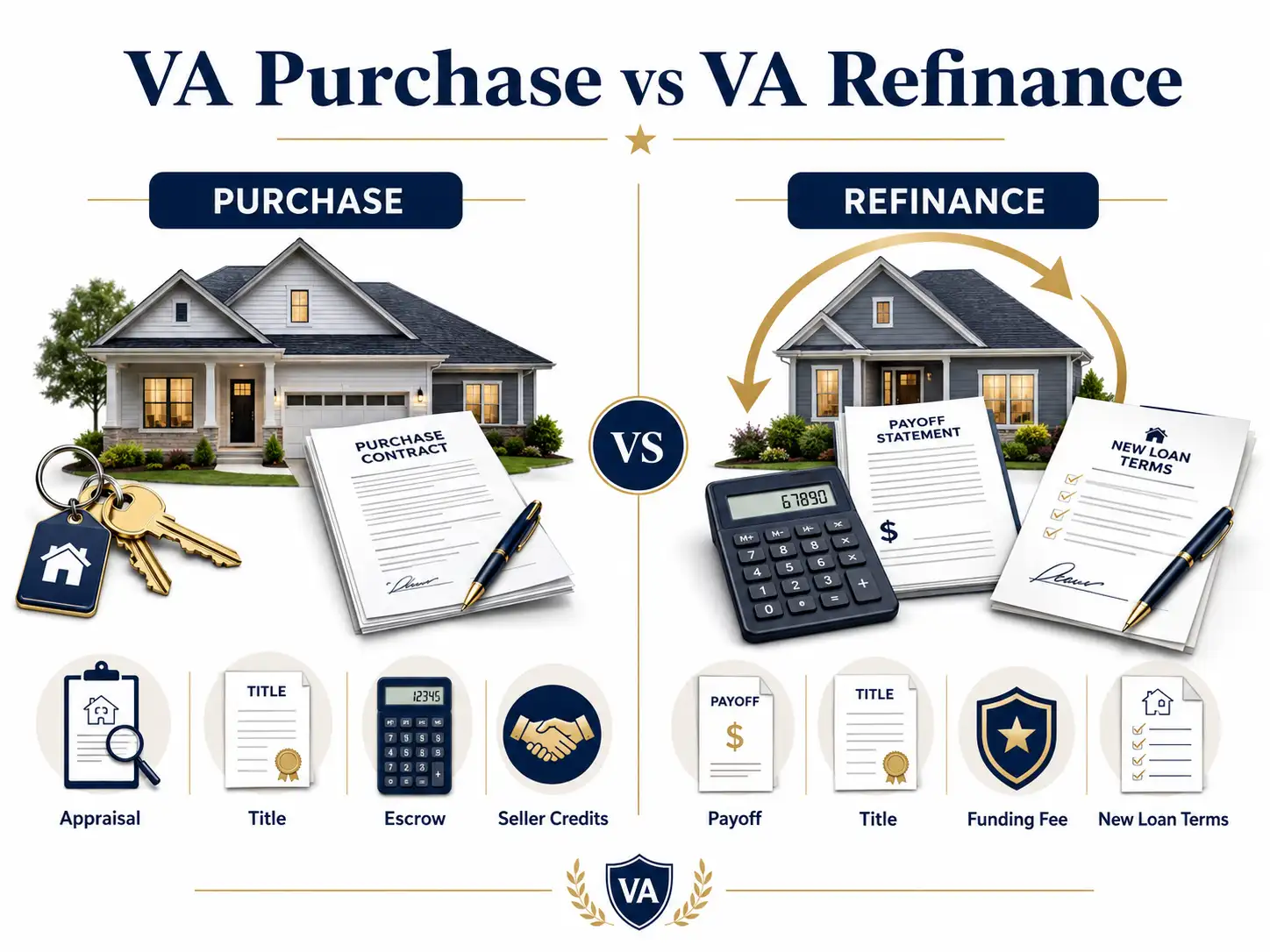
VA purchase loans and VA refinance loans can have different closing cost structures. Borrowers should not assume all VA closing costs work the same way across every loan type.
A VA purchase loan may include contract terms, seller concessions, appraisal fees, title charges, recording fees, prepaid property taxes, homeowners insurance, and escrow setup. Official VA purchase loan information can help borrowers understand the purchase loan benefit at a high level.
A VA cash out refinance may involve payoff details, title work, appraisal, lender fees, funding fee review, and a new loan structure. A VA IRRRL may have a different purpose and cost structure from a purchase loan or cash out refinance.
Borrowers can review the broader VA-backed home loan overview when comparing VA loan types, but file-specific costs still depend on the lender, property, title, and underwriting.
A VA refinance should be compared with current mortgage terms, new costs, monthly payment, funding fee if applicable, and long-term goals.
How Do VA Loan Closing Costs Compare With Other Mortgage Options?
VA loans may offer strong benefits for eligible borrowers, but closing costs should still be compared with other mortgage options. The best choice depends on the borrower’s eligibility, cash to close, monthly payment, long-term plans, and property details.
VA financing can be compared with VA loan options, FHA loan options, USDA loan options, and conventional loan options. Each program can have different rules for down payment, mortgage insurance, guarantee fees, appraisal, property eligibility, and closing costs.
Borrowers may also compare VA purchase costs with mortgage refinance options if they already own a home and want to review a new loan structure.
VA is not automatically cheaper or better for every borrower. FHA may include mortgage insurance, conventional loans may include PMI depending on down payment, and USDA loans may have different property-location and guarantee-fee rules.
The strongest comparison includes cash to close, monthly payment, funding fee, mortgage insurance, seller credits, lender credits, APR, and long-term affordability.
What Mistakes Should Borrowers Avoid With VA Loan Closing Costs?
VA closing costs can become confusing when borrowers focus only on the benefit and not the full cash-to-close picture. The safest approach is to review estimated costs early and compare them again before closing.
Assuming VA loans have zero closing costs
Forgetting about prepaid taxes and homeowners insurance
Forgetting about escrow setup
Ignoring the VA funding fee
Assuming everyone is exempt from the VA funding fee
Assuming the seller must pay closing costs
Assuming lender credits are free
Comparing only the interest rate
Ignoring APR and total loan cost
Not reviewing the Loan Estimate
Not reviewing the Closing Disclosure
Waiting too long to ask about cash to close
Making an offer without discussing seller concessions
Not comparing VA with FHA, USDA, conventional, or refinance options
Not getting pre approved before shopping
Borrowers should compare VA loan closing costs based on cash to close, monthly payment, funding fee, seller credits, lender credits, and long-term affordability rather than assuming VA means zero cost.
What Real-Life VA Loan Closing Cost Scenarios Can Tulsa Buyers Learn From?
Could a Tulsa Veteran Need Cash to Close Even With a VA Loan?
A Tulsa Veteran may use VA financing and still need funds for prepaid taxes, homeowners insurance, escrow setup, appraisal, title charges, or other allowed costs. This hypothetical buyer should review the Loan Estimate before assuming the cash-to-close amount.
This example does not guarantee approval, seller-paid costs, lender credits, or a specific cash-to-close amount. Final costs depend on the borrower, property, contract, lender, title review, appraisal, and underwriting.
Could a Broken Arrow Buyer Use Seller Credits to Reduce VA Closing Costs?
A Broken Arrow buyer may negotiate seller help through the purchase contract. Seller credits can reduce buyer cash to close in some cases, but they depend on the seller, market conditions, contract terms, VA rules, and lender review.
The buyer should discuss seller concessions before writing the offer. Waiting too long may limit the ability to structure the contract around closing cost needs.
Could an Owasso Buyer Compare VA, FHA, USDA, and Conventional Costs?
An Owasso buyer may qualify for more than one mortgage option. VA, FHA, USDA, and conventional loans can differ in down payment, funding fee, mortgage insurance, guarantee fees, property rules, and closing cost structure.
The right option depends on eligibility, cash to close, monthly payment, property type, income, debts, long-term goals, and underwriting.
How Should Borrowers Prepare Before Reviewing VA Loan Closing Costs?
Preparation makes VA closing cost conversations easier. Borrowers should gather basic information before making an offer or choosing a lender structure.
Helpful items to review include:
VA eligibility
Certificate of Eligibility
Entitlement
Purchase price or refinance goal
Loan type
Funding fee status
Possible funding fee exemption
Credit score and credit history
Income documents and employment history
Monthly debts and residual income
Cash-to-close expectations
Seller concession strategy
Lender credit options
Appraisal expectations
Title fees, property taxes, homeowners insurance, and escrow setup
Loan Estimate and Closing Disclosure review
Long-term affordability and pre approval timing
Borrowers can review VA Certificate of Eligibility information to understand how COE requests work. They can also review credit reports through AnnualCreditReport.com before applying.
A full loan comparison may include broader home loan programs and a mortgage pre approval review before house hunting.
If you are ready to compare VA closing costs, a local review can help you understand funding fee status, seller credit options, lender credits, cash to close, and your next step before making an offer.
Review VA Loan Closing Cost Options
What Questions Do Tulsa Borrowers Ask About VA Loan Closing Costs?
What Are VA Loan Closing Costs?
VA Loan Closing Costs are the fees, prepaid items, escrow costs, and possible VA funding fee connected to a VA-backed purchase or refinance. The final amount depends on the loan file, property, contract, lender, and underwriting.
Do VA Loans Have Closing Costs?
Yes. VA loans can still have closing costs even though they may offer major benefits for eligible borrowers. Costs may include lender fees, appraisal, title, recording, prepaid items, escrow, and funding fee when applicable.
Who Pays Closing Costs on a VA Loan?
Closing costs may be paid by the buyer, seller, lender credits, or handled through the loan structure when allowed. The final responsibility depends on the contract, lender, VA rules, and loan file.
What Is the VA Funding Fee?
The VA funding fee is a program fee that may apply to some VA borrowers. It can vary by loan type, first use or subsequent use, down payment amount, and current VA rules. Some borrowers may be exempt.
Can the Seller Pay VA Loan Closing Costs?
A seller may agree to pay certain allowed costs through the purchase contract, subject to VA rules and lender review. Seller-paid costs are not guaranteed and should be discussed before writing the offer.
Can Closing Costs Be Rolled Into a VA Loan?
Some costs may be handled through loan structure when allowed, especially in certain refinance situations. Purchase and refinance rules can differ, so borrowers should review the Loan Estimate carefully.
Are VA Refinance Closing Costs Different From Purchase Costs?
Yes, they can be different. A purchase loan may involve contract terms and seller concessions, while a refinance may involve payoff details, title work, appraisal, and different cost treatment.
Should I Get Pre Approved Before Comparing VA Closing Costs?
Yes. Pre approval can help review eligibility, credit, income, residual income, loan type, funding fee status, and estimated cash to close before a borrower shops seriously or makes an offer.
What Should Borrowers Know Before Relying on This VA Loan Closing Costs Guide?
VA Loan Closing Costs information is educational only and should be reviewed for accuracy by a licensed mortgage professional before publishing or relying on it for a loan decision.
VA financing does not guarantee approval, zero closing costs, seller-paid costs, lender credits, funding fee exemption, lower payment, savings, lower rate, lower closing costs, or final loan terms.
Loan approval and costs depend on VA eligibility, Certificate of Eligibility, entitlement, credit, income, residual income, debt-to-income ratio, loan type, property value, contract terms, lender requirements, title review, appraisal, market conditions, and underwriting.
Information may change, so borrowers should confirm current VA guidelines, funding fee rules, closing cost rules, seller concession rules, lender credit options, and program requirements before making a final decision.
For official policy review, borrowers and mortgage professionals can use the VA Lender’s Handbook as a technical resource.
Last Updated: 4th June 2026
Reviewed By: Alfredo Madrid , NMLS #266006